Free care label tool
Laundry Symbol Decoder: What Your Care Label Means
A washtub with 40 and one bar means machine wash at up to 40 °C on a mild cycle; an iron with two dots means up to 150 °C; a triangle with two lines means non-chlorine bleach only, and a cross over any symbol means do not. Pick the symbols on your label below to decode them all at once.
- Washing: 40 °C, mild
Machine wash at up to 40 °C on a mild (easy-care or synthetics) cycle. - Bleaching: Non-chlorine only
Use only oxygen (non-chlorine) bleach. Chlorine bleach is not allowed. - Tumble drying: Tumble dry, low heat
Tumble dry at a reduced (low) temperature. - Ironing: Iron, medium (150 °C)
Iron at a maximum sole-plate temperature of 150 °C (wool, polyester, viscose). - Professional care: Dry clean (P)
Professional dry cleaning in tetrachloroethylene (perc) or hydrocarbon solvents, normal process.
A milder treatment than the one shown is always acceptable. When a symbol is missing, the label gives no instruction for that treatment.
How to read a care label
- Read left to right: Symbols appear in the order washing, bleaching, drying, ironing, professional textile care.
- Washing: The number in the tub is the maximum washing temperature in °C; one bar = mild process, two bars = very mild process.
- Dots mean heat: Ironing dots: one = 110 °C, two = 150 °C, three = 200 °C maximum sole-plate temperature; in the tumble dryer square, one dot is low heat and two dots normal heat.
- A cross means do not: a cross over any symbol means that treatment must not be used.
- Milder is fine: A milder treatment than the one shown is always acceptable.
Laundry symbols chart
| Symbol | Meaning |
|---|---|
| Washing: 95 °C, normal Machine wash at up to 95 °C on a normal (cotton) cycle. Typical for white cotton and linen. | |
| Washing: 70 °C, normal Machine wash at up to 70 °C on a normal cycle. | |
| Washing: 60 °C, normal Machine wash at up to 60 °C on a normal cycle. | |
| Washing: 60 °C, mild Machine wash at up to 60 °C on a mild (easy-care or synthetics) cycle with reduced agitation. | |
| Washing: 50 °C, normal Machine wash at up to 50 °C on a normal cycle. | |
| Washing: 50 °C, mild Machine wash at up to 50 °C on a mild (easy-care or synthetics) cycle. | |
| Washing: 40 °C, normal Machine wash at up to 40 °C on a normal cycle. | |
| Washing: 40 °C, mild Machine wash at up to 40 °C on a mild (easy-care or synthetics) cycle. | |
| Washing: 40 °C, very mild Machine wash at up to 40 °C on a very mild (wool or delicates) cycle with minimal agitation. | |
| Washing: 30 °C, normal Machine wash at up to 30 °C on a normal cycle. | |
| Washing: 30 °C, mild Machine wash at up to 30 °C on a mild (easy-care or synthetics) cycle. | |
| Washing: 30 °C, very mild Machine wash at up to 30 °C on a very mild (wool or delicates) cycle. | |
| Washing: Hand wash Wash by hand only, at no more than 40 °C. Do not rub or wring. | |
| Washing: Do not wash Do not wash at home. Check the professional care symbol. | |
| Bleaching: Any bleach Any bleach may be used, including chlorine. | |
| Bleaching: Non-chlorine only Use only oxygen (non-chlorine) bleach. Chlorine bleach is not allowed. | |
| Bleaching: Do not bleach Do not use any bleach. | |
| Tumble drying: Tumble dry, low heat Tumble dry at a reduced (low) temperature. | |
| Tumble drying: Tumble dry, normal Tumble dry at a normal temperature. | |
| Tumble drying: Do not tumble dry Do not tumble dry. Dry naturally (on a line, hanger or flat) as the label or fabric suggests. | |
| Ironing: Iron, low (110 °C) Iron at a maximum sole-plate temperature of 110 °C (silk, acrylic, nylon). Steam may damage the fabric. | |
| Ironing: Iron, medium (150 °C) Iron at a maximum sole-plate temperature of 150 °C (wool, polyester, viscose). | |
| Ironing: Iron, high (200 °C) Iron at a maximum sole-plate temperature of 200 °C (cotton, linen). | |
| Ironing: Do not iron Do not iron or steam. | |
| Professional care: Dry clean (P) Professional dry cleaning in tetrachloroethylene (perc) or hydrocarbon solvents, normal process. | |
| Professional care: Dry clean (P), mild Professional dry cleaning in tetrachloroethylene or hydrocarbon solvents, mild process. | |
| Professional care: Dry clean (F) Professional dry cleaning in hydrocarbon solvents only, normal process. | |
| Professional care: Dry clean (F), mild Professional dry cleaning in hydrocarbon solvents only, mild process. | |
| Professional care: Wet clean (W) Professional wet cleaning, normal process. | |
| Professional care: Wet clean (W), mild Professional wet cleaning, mild process. | |
| Professional care: Wet clean (W), very mild Professional wet cleaning, very mild process. | |
| Professional care: Do not dry clean Do not dry clean. |
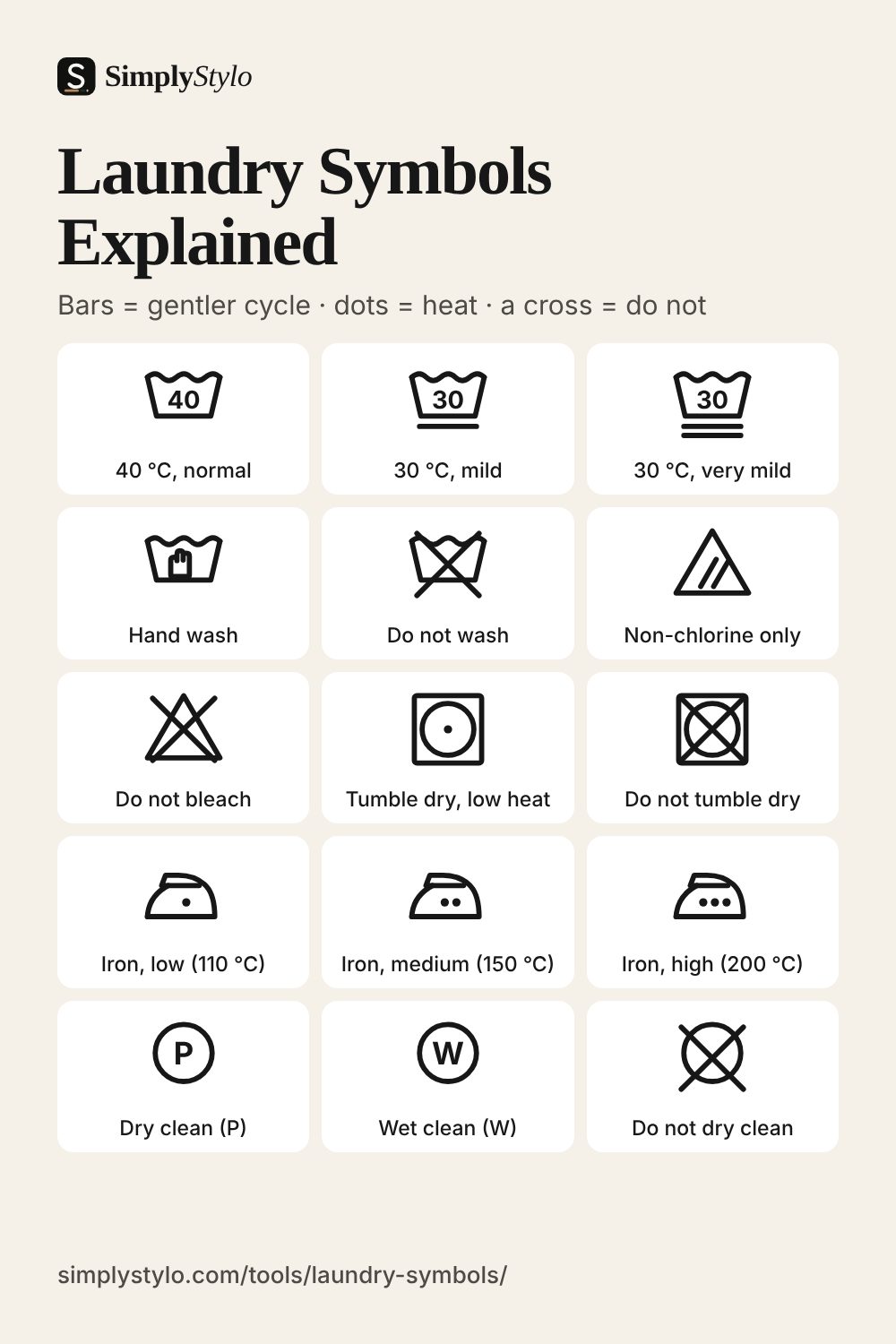
Natural drying symbols (line, drip, flat and shade drying) are drawn differently on ISO and US labels, so they are described here rather than decoded. US labels (ASTM D5489) can show washing temperature as dots instead of numbers: 1 dot 30 °C, 2 dots 40 °C, 3 dots 50 °C, 4 dots 60 °C. The care symbols are trademarks of GINETEX, shown here to explain care labels.
Sources and method
- ISO 3758:2012 Textiles: care labelling code using symbols (preview, Table 1): washing temperatures and processes; hand wash 40 °C
- The worldwide care labelling system (GINETEX): symbol order, bars, dots and the St Andrew's cross
- Laundry symbol (Wikipedia): ironing at 110, 150 and 200 °C; P, F and W
- SimplyStylo methodology
Frequently asked questions
What do the dots on a laundry symbol mean?
On the iron, dots set the maximum temperature: one = 110 °C, two = 150 °C, three = 200 °C maximum sole-plate temperature. In the tumble dryer square, one dot means low heat and two dots normal heat. Some US labels also use dots in the washtub instead of a number: 1 dot 30 °C, 2 dots 40 °C, 3 dots 50 °C, 4 dots 60 °C.
What does a line under the washing symbol mean?
One bar under the washtub means a mild process (an easy-care or synthetics cycle with reduced agitation and spin); two bars mean a very mild process for wool and delicates. No bar means a normal cycle.
What does the triangle symbol mean on clothes?
The triangle is bleaching. An empty triangle allows any bleach, including chlorine; a triangle with two diagonal lines allows only oxygen (non-chlorine) bleach; a crossed-out triangle means do not bleach.
What is the maximum temperature for hand wash?
The hand-in-tub symbol means wash by hand only, at no more than 40 °C, according to ISO 3758. Squeeze gently rather than rubbing or wringing.
What do P, F and W in a circle mean?
The circle is professional care. P means dry cleaning in tetrachloroethylene (perc) or hydrocarbon solvents, F means hydrocarbon solvents only, and W means professional wet cleaning. A bar underneath asks for a milder process.
What does a square with a circle inside mean?
A circle inside a square means tumble drying is allowed: one dot for low heat, two dots for normal heat. Crossed out, it means do not tumble dry. A square with lines but no circle is a natural drying symbol, such as line or flat drying.
Can I wash clothes at a lower temperature than the label says?
Yes. The number is a maximum, and a milder treatment than the one shown is always acceptable: 30 °C is fine for a 40 °C label, and a mild cycle is fine for a normal one.